The mark, the palette, and the rules
Openfield should read as a calm financial environment rather than an aggressive crypto venue. Everything below exists to make that consistent, and to let anyone writing about us do it correctly without asking.
The mark
A field with a shape held inside it, drawn as a single crescent. The negative space is the point: an open field with an object placed in it, not a logo with a hole. It works down to sixteen pixels because it is one path with one counter.
Watch
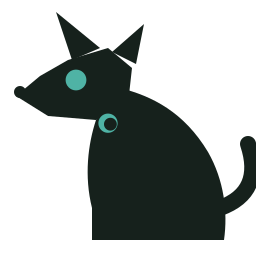
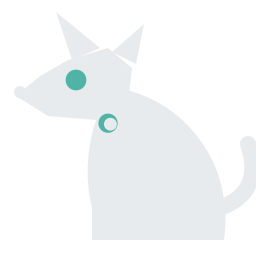
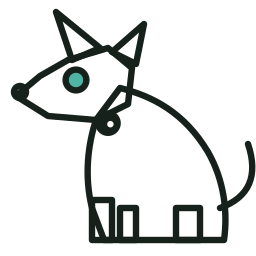
The living interface of RiskOS. He watches the market when you can’t. A geometric dark silhouette with one eye that follows the regime; the medallion is the Openfield mark. Never a meme, never a toy: he takes one to two percent of the screen, speaks only when risk changes, and can be sent home.
watcha-dark.svgwatcha-light.svgwatcha-outline.svg
mark.svgmark-64.pngicon-512.png



Lockup
The wordmark is set in Manrope SemiBold, all lowercase, with the mark to its left at cap height and a gap of roughly half the mark's width. The word is never capitalised, never spaced out, and never set in the serif.
Do not
- Rotate, skew, or add a gradient, glow or drop shadow to the mark.
- Fill the counter, or place the mark on a busy image without a solid plate behind it.
- Recolour it to anything outside the palette below, including a brand red or a rainbow.
- Set the wordmark with a capital O, or as two words.
- Pair it with the word "exchange", "protocol" or "DEX" as if it were part of the name.
The screens
Every surface of the venue as it ships, captured from the running engine rather than drawn, including the parts that only exist while something is being done: a cursor on a curve, a value asked to explain itself, a position being let out, the palette open. Build v0.26.0. Take the whole book, or a single screen.
The terminal, screen by screen 35 screens, desktop and phone, one book PDF · 16.4 MB · 36 pages · v0.26.0Desktop · 1680 × 1050
Phone · 390 × 844
Palette
Carbon is the default. Paper is a full alternate, not a washed-out inversion, and every screen must be legible in both. Colour carries meaning here: green is confidence, amber is caution, red is loss. None of the three is decorative, so none of them should appear where they do not mean that.
Carbon
Paper
Type
Prices, confidence, leverage, basis points and timestamps are always monospaced and always tabular, so a column of numbers does not shift as it updates. Prose is never monospaced to look technical.
Voice
We write
Plainly, in full sentences, in the same register whether the news is good or bad. We publish the derivation, name the limitation, and use the ordinary word rather than the industry one. Calm is the point: the product's argument is that it stays legible under stress, and the writing has to demonstrate that rather than claim it.
We do not write
Hype, urgency, countdowns, rocket language, or "revolutionary". We do not promise returns, imply safety we have not engineered, or describe a limitation as a feature. We do not use a phrase like "X is not Y" as a rhetorical crutch, and we do not describe the alpha as anything other than an alpha.
Using our name
Openfield, one word, capital O in prose and lowercase in the wordmark. It is a paper-trading alpha and should be described as one. You are welcome to screenshot the terminal, quote anything on this site, and reproduce the mark unmodified when writing about us. Please do not present Openfield as live, funded, regulated or audited, because it is none of those things yet.
Press and anything else: hello@openfield.markets
For X
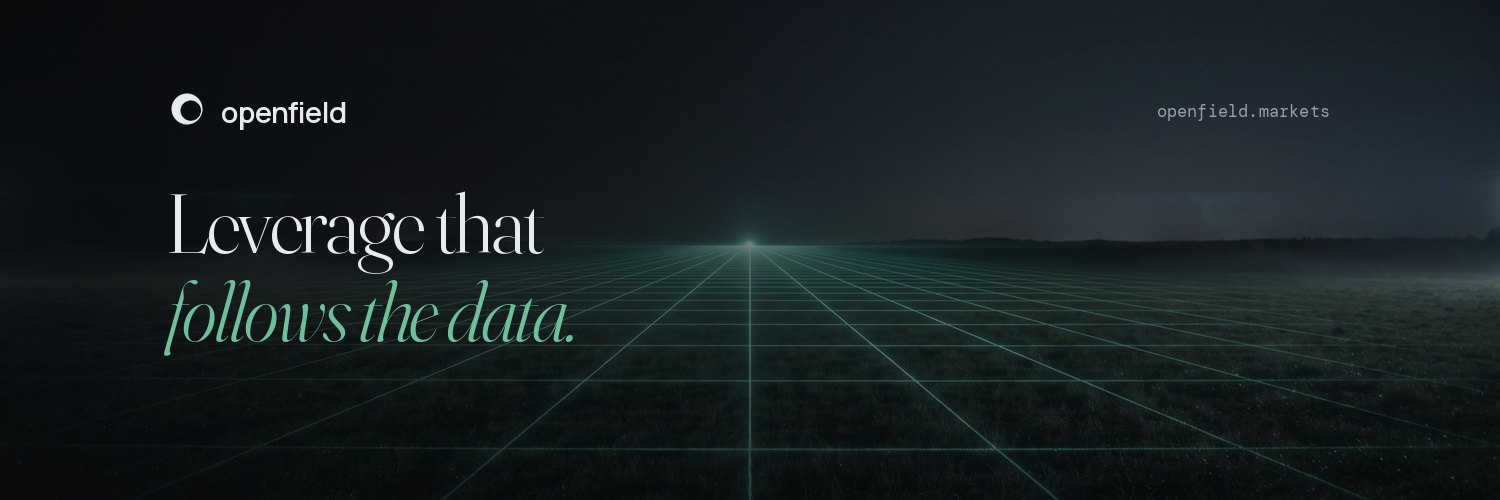
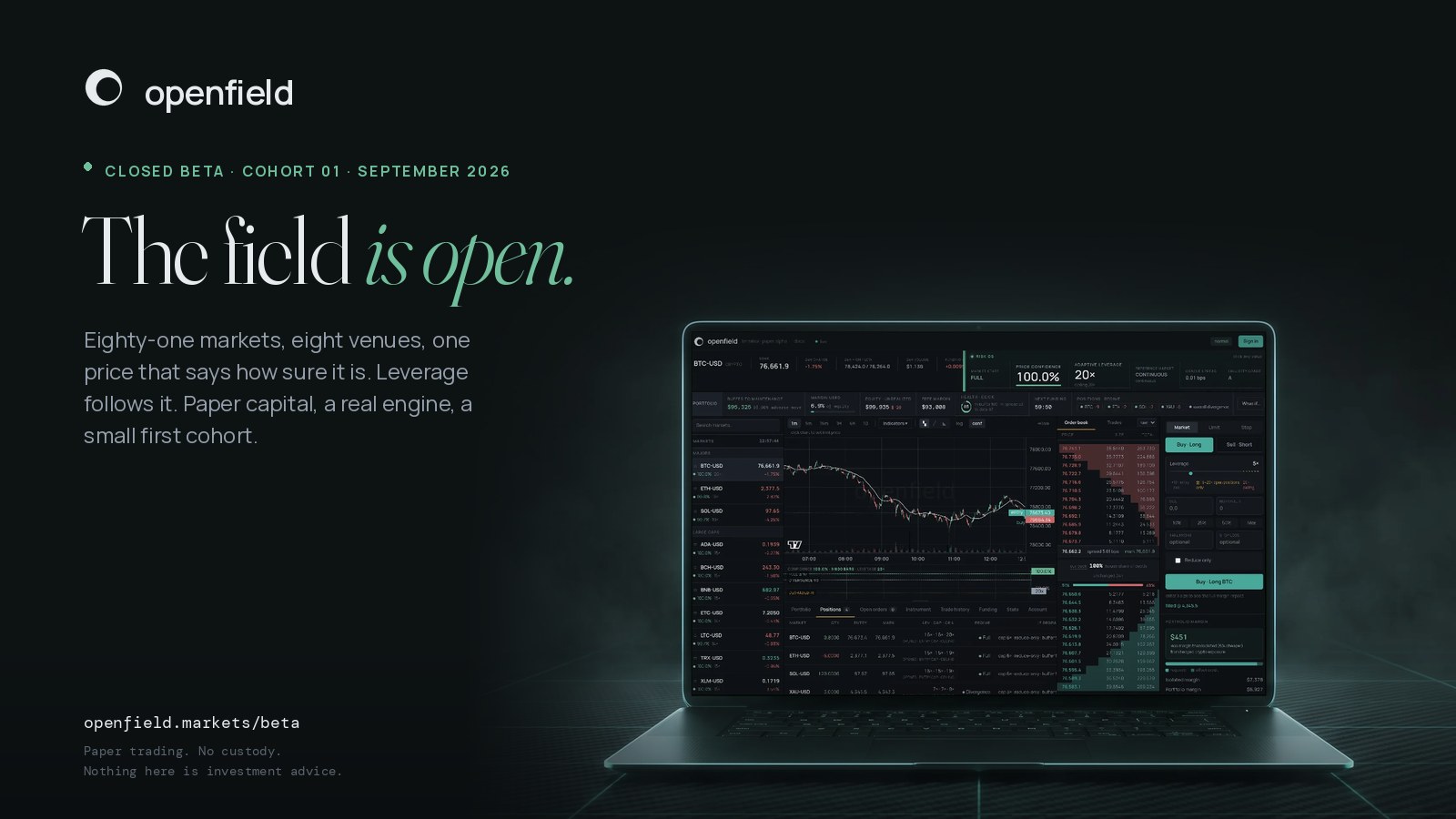
Everything the profile needs, in the sizes X asks for. Headers keep their text inside the central 1200 by 380 pixels, because the profile crops the edges and the avatar covers the bottom left corner. Avatars are square and X rounds them. Cards are what a link unfurls to, and the announcement plate is the image for the launch post. Same fonts, same palette, same mark as everywhere else, so nothing here needs a second approval.
Headers · 1500 × 500

Avatar · 400 × 400 and 800 × 800






Link cards · 1200 × 628
Announcement · 1600 × 900
Profile
Counts are raw characters. X counts any link as 23, so a line with a link has more room than the number shows.
Openfield
@openfield
Leverage that follows the data. A derivatives venue where margin, leverage and liquidation move with the engine's confidence in its own price. Pre-launch.
A derivatives venue that says how sure it is of its own price and sizes your leverage to match. 91 markets, 8 venues, paper capital. Pre-launch, cohort 01.
The field
https://openfield.markets
Openfield is in pre-launch and cohort 01 is open.

One price built from up to eight venues, a confidence figure printed next to it, and leverage that follows that figure while you hold the position. Paper capital, a real engine.

Apply: https://openfield.markets/beta/
If the handle is taken, the fallback is @openfieldmkts, which fits the fifteen character limit. Avoid @openfield_io, @openfieldxyz and anything with "exchange" in it.
Launch thread
Seven posts. The first stands on its own with the announcement plate attached; the last carries the two links. Post them in order, then pin the first.
Openfield opens its first pre-launch today. It is a derivatives venue where leverage, margin and liquidation follow how much the engine trusts its own price. Paper capital, a real engine, a small first cohort. What that means, in six posts.
2/ Price is an estimate. Up to eight venues feed every market, the engine forms one price and attaches a confidence figure to it. When sources disagree, go stale or drop out, the figure falls, and the derivation is printed on screen.
3/ Leverage follows confidence. The ceiling belongs to the market. What you get is the ceiling minus what the engine cannot see: divergence between venues, volatility, gaps in the tape. When it comes down, the account is told why, in numbers.
4/ Liquidation is a forecast. Because margin moves with the data, the venue can say what the data is about to do to you. A push alert names the market, the cut and your buffer, and the forward look on every position shows the next step before it lands.
5/ Everything is written down. Every order, cancel, fill, funding tick and regime change appends to a hash-chained journal. Your export reproduces what the engine did to your account, and every change during the pre-launch goes into the changelog with a date.
6/ What the pre-launch is: 91 markets, up to eight venues, portfolio margin, a maker API, share cards from the terminal, paper capital. What it is still: an alpha, with its limitations listed in the docs before you apply.
7/ Cohort 01 is small and one seat is one person. Read the replay first, it shows where the engine loses: https://openfield.markets/replay/

Then apply: https://openfield.markets/beta/
Share cards
Three shorter posts for the position and book cards that the terminal renders. Attach a real card from a real account to each.
Position cards, from the terminal. Entry, mark, estimated liquidation, leverage and distance to maintenance, drawn on your device in the venue's own style. The numbers travel with the screenshot, so the argument can be checked.
Book cards. Your whole book as one image: equity, the day's result, every position with its side and return. Rendered locally, nothing leaves the device until you tap share.
Every card carries the paper disclaimer and your referral link. Take one when the confidence band widens; that moment is the reason the venue exists. Open the app: https://app.openfield.markets/